
Whole Body Cryotherapy: A Long Term Weight/Fat Loss Method
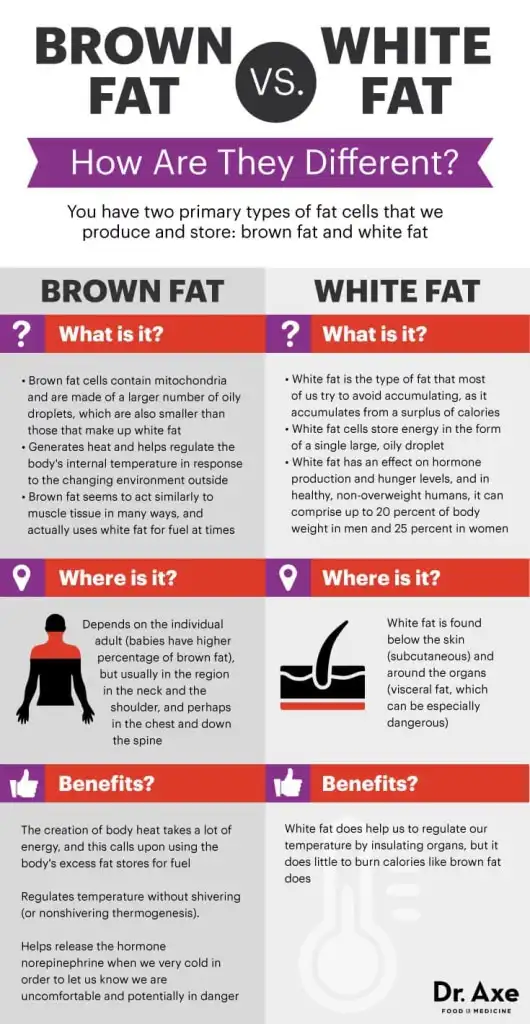
In addition to the high calorie burn achieved during a three-minute whole-body cryotherapy session, weight-loss benefits result from increased metabolic rate and appetite suppression. How does this work? It’s incredibly scientific! As explained below, it all has to do with brown fat and leptin. Brown fat is different from regular white fat, which plagues most of us in our abdomens, hips, thighs, and elsewhere. White fat is passive–it simply stores energy. In contrast, brown fat is known to be metabolically active and has been proven to BURN fat! The holy grail of weight and fat loss is to somehow convert white fat stores to brown fat–this conversion leans the body out, increases metabolism, and gives us more energy!
Whole body cryotherapy has been shown to convert white fat to brown fat. Yes!
Additionally, leptin is a hormone produced by fat that regulates appetite: the more fat you have, the more leptin you produce. Ideally, leptin signals to your brain that you are full and should stop eating. The universal problem with weight loss is that as you reduce your fat, you also reduce your leptin production–inevitably, therefore, as you lose weight, your appetite increases and you may actually gain the weight back….So the second holy grail of long-term weight loss is to somehow maintain your leptin levels as you lose weight. This will avoid rubber-band weight loss/weight gain…
Luckily, it has been shown that whole-body cryotherapy increases leptin production. This is the reason why our clients often report losing weight simply because their appetites are suppressed. Better yet–you can lose weight without being HUNGRY (or in the case of many of us, HANGRY!).
Whole-body cryotherapy is a 3-minute treatment that burns 500 to 800 calories, converts white fat to brown fat, and suppresses appetite by stimulating leptin production.
By Steven Guyenet
Steven is an obesity researcher, neurobiologist, and author with a Ph.D in neurobiology.
Brown Fat: It’s a Big Deal
Non-shivering thermogenesis is the process by which the body generates extra heat without shivering. Shivering is a way for the body to use muscular contractions to generate heat, but non-shivering thermogenesis uses a completely different mechanism to accomplish the same goal: a specialized fat-burning tissue called brown fat. Brown fat is brown rather than white because it’s packed with mitochondria, the power plants of the cell. Under cold conditions, these mitochondria are activated, using a specialized molecular mechanism called uncoupling* to generate heat.
The mechanism of brown fat activation has been worked out fairly well in rodents, which rely heavily on non-shivering thermogenesis due to their small body size. Specialized areas of the hypothalamus sense body temperature (through sensors in the brain and body), body energy status (by measuring leptin and satiety signals), stress levels, and probably other factors, and integrate this information to regulate brown fat activity. The hypothalamus does this by acting through the sympathetic nervous system, which heavily innervates brown fat. As an aside, this process works basically the same in humans, as far as we currently know. Those who claim that rodent models are irrelevant to humans are completely full of hot air**, as the high degree of conservation of the hypothalamus over 75 million years of evolution demonstrates.
Two new studies, published concurrently in the Journal of Clinical Investigation last week, demonstrate what I’ve suspected for a long time: brown fat can be ‘trained’ by cold exposure to be more active, and its activation by cold can reduce body fatness.
It has previously been shown that non-shivering thermogenesis is higher in winter than in summer in the same individuals (1), suggesting that it may be a modifiable trait. As an aside, obese people tend to have low brown fat activity (2)****. The first new study demonstrates that brown fat can be trained to become more active in as little as 10 days, and that this training makes people more cold-tolerant (3). The protocol involved exposing people to 60°F (15-16°C) air for 2 hours on day 1, 4 hours on day 2, and 6 hours on days 3-10. Although I assume they were lightly clothed, this is a pretty mild cold exposure.
The second study went further, using a longer cold-exposure protocol to investigate changes in fat mass among people with low baseline brown fat activity (4). Researchers exposed volunteers to 63°F (17°C) air for two hours a day over a six-week period; again, I assume they were lightly clothed. As in the previous study, they observed an increase in brown fat activity with cold training and found that calorie expenditure was higher when subjects were in ‘cold’ air. After six weeks of training, body fat mass had declined by about 5 percent. This is despite the fact that all subjects were lean to begin with!
I think this is pretty impressive, given how wimpy the cold exposure protocol was. Think about it: two hours a day at 63°F. That would seem downright luxurious to a person 100 years ago in winter in almost any temperate climate. Today, most people keep their central heat set to around 70°F in winter, apparently eliminating a major source of passive calorie burning.
I’ve used heat in my bedroom about 20 times over the last three years, usually when I have a guest. I use less heat because I’m an environmentalist, and because I feel that humans are meant to experience cold stress sometimes, just as we’re meant to experience exercise stress. The winters aren’t particularly cold in Seattle, and I lose heat downstairs, but the temperature still fluctuates between 45 and 55°F for several months, with occasional excursions below 40°F (I’ve awakened to a crust of ice on the inside of my windows).
This may sound extreme, but it’s nothing compared to how many people in temperate climates lived in the winter before central heat. Open wood hearths are inefficient at heating a house, wood can be expensive, and the fire burns out overnight. Have you ever experienced a temperature below freezing in your home? It’s difficult to stay warm without moving your body, and I must confess it’s hard for me to tolerate it for long, despite my relative cold hardiness. Indoor temperatures below freezing would have been common two centuries ago, as supported by many historical accounts of even the wealthy having to break ice to wash their faces in the morning.
Is the rise of central heating a contributor to the obesity epidemic? These recent studies suggest that it may be. This is consistent with what one would predict based on the evolutionary/ancestral health principle.
* As protons are pumped across the mitochondrial inner membrane as part of the normal process of ATP generation, a channel protein called UCP1 (uncoupling protein 1) diffuses the proton gradient by allowing protons to cross back passively. Since heat is nothing more than molecules moving around, pumping protons back and forth generates heat. This process is called uncoupling because the Krebs cycle is uncoupled from ATP generation by the diffusion of protons down their gradient.
** It is true that certain things don’t carry over that well from rodents to humans, for example, drug efficacy and perhaps the effects of certain diet elements on health. But basic anatomy and physiology are remarkably conserved in many areas. If you look at a rat’s hypothalamus, it contains all the same structures as a human hypothalamus, though the proportions and placement are different. Same for the basal ganglia and many other major systems in the brain (the basal ganglia, remarkably, are highly conserved down to hagfish, the most primitive vertebrate). It’s difficult to argue that these structures function completely differently in rodents than in humans when they look the same down to the cellular level, and we have empirically determined, in many cases, that they function similarly in rodents and humans. I sometimes hear the impassioned argument “I am not a rat/mouse”! Well, actually, you are. We share roughly 99% of our genes with mice, and 85% of the sequence of those genes is identical at the nucleotide level. So yes, you are a mouse, roughly speaking***.
*** OK, to be fair, small changes in the genome can have major phenotypic impacts, so percent genome identity isn’t necessarily the last word. But science has abundantly demonstrated the usefulness of rodent models for understanding how humans work, and these insights will keep rolling in whether skeptics like it or not. Much of this skepticism is inspired by animal rights sentiments, and/or the inherent distaste people have for being compared to an animal they consider disgusting and stupid. Although I sympathize with animal rights sentiments, and I think they should be part of the animal research discussion, they have nothing to do with the question of how useful animal research is for understanding humans. The argument from disgust is obviously irrational.
**** This could simply be because they’re better insulated. Overall metabolic rate (kcals burned per unit lean mass per unit time, or total kcals burned per individual per unit time) is actually higher in the obese.