
Cryotherapy Treats & Prevents Tennis & Golf Elbow
Tennis and Golf Elbow: Not Just for Roger Federer or Phil Mickelson…
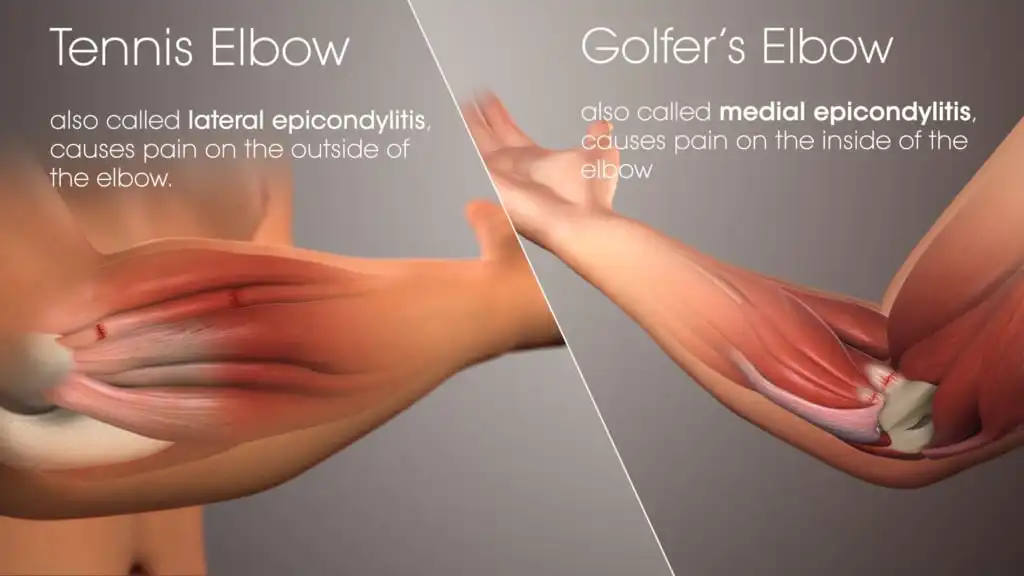
You don’t have to play tennis or golf to have these two injuries. Both Tennis and Golfer’s Elbow are forms of epicondylitis: inflammation of the tendons that attach to the elbow.
Tennis elbow, or lateral epicondylitis, is an overuse and muscle strain injury that results in inflammation outside of the elbow and forearm areas. Plumbers, carpenters, painters, and cooks are prone to this type of injury. The injury can also be caused by raking, gardening, cutting wood, or playing sports like tennis and golf.
With tennis elbow, pain may radiate from the outer elbow to the forearm and wrist. It can be a constant ache in the elbow area, or you may feel it only during activities that involve reaching, grasping, or lifting.
Medial epicondylitis, or Golfer’s Elbow, is inflammation on the inner side of the arm and elbow. This condition can be caused by any activity that requires repeated twisting or flexing (bending downwards) of the wrist. Generally, it is an overuse of the forearm muscles during tasks such as gardening, shoveling, throwing a ball, or playing golf or tennis. Repeated lifting, especially when your elbow is extended and your palm is facing down, can also cause Golfer’s Elbow. In addition to golf, other activities may cause this condition, such as racquet sports, baseball or softball, weightlifting, carpentry, painting, and other similar activities.
With golf elbow, pain occurs on the inner side of the elbow when lifting the wrist or hand, twisting the forearm, or making a fist. The area may be slightly swollen or tender to the touch. If the problem has lasted for a while, additional symptoms may include elbow stiffness or weakness in the hands or wrists.
Pain, swelling, redness, and warmth are all part of the acute inflammation response. This inflammation response is supposed to be fast and direct, not extended. If you notice these symptoms, it is important to address the injury as soon as possible. Allowing the injury and inflammation to become chronic (i.e., lasting more than 4 weeks) usually means that more sustained, intensive treatment will be required.
At Chill Cryotherapy, we effectively treat acute tennis and golf elbow with local cryotherapy to immediately reduce inflammation and pain. Stiffness and mobility will also improve. Prompt attention to the symptoms of tennis and golf elbow will help you get back to the activities you love quickly!
If you are facing a more serious injury that is now chronic, Chill Cryotherapy will recommend a combination of whole body and local cryotherapy to address the injury. Chronic epicondylitis suggests inflammation throughout your body. It is important to reduce overall inflammation in the body to ensure the nagging injury fully heals and goes away! Whole body cryotherapy will reduce systemic inflammation throughout your body—so not only will your tennis and golf elbow improve, everything else in your body will too! Enjoy improved mobility, flexibility, higher energy levels (both mental and physical), better sleep, optimism, and lose weight!!
A word on prevention: a regular cryotherapy regimen will help prevent injuries such as tennis and golf elbow by maintaining a low-inflammatory environment throughout the body. Cryotherapy has been shown to accelerate healing, so micro-tears, strains, and exertion will not lead to serious injuries. If you are active or engage in activities that stress and strain your body, cryotherapy can help prevent injuries.
Bottom Line with tennis and golf elbow: address the inflammation as quickly as possible to ensure a complete recovery. We know you love to golf, play tennis, and enjoy your life! Don’t let inflammation and pain take you out of the game of life. Come Chill!